07 Plan Performance
7.1 How Money Flows
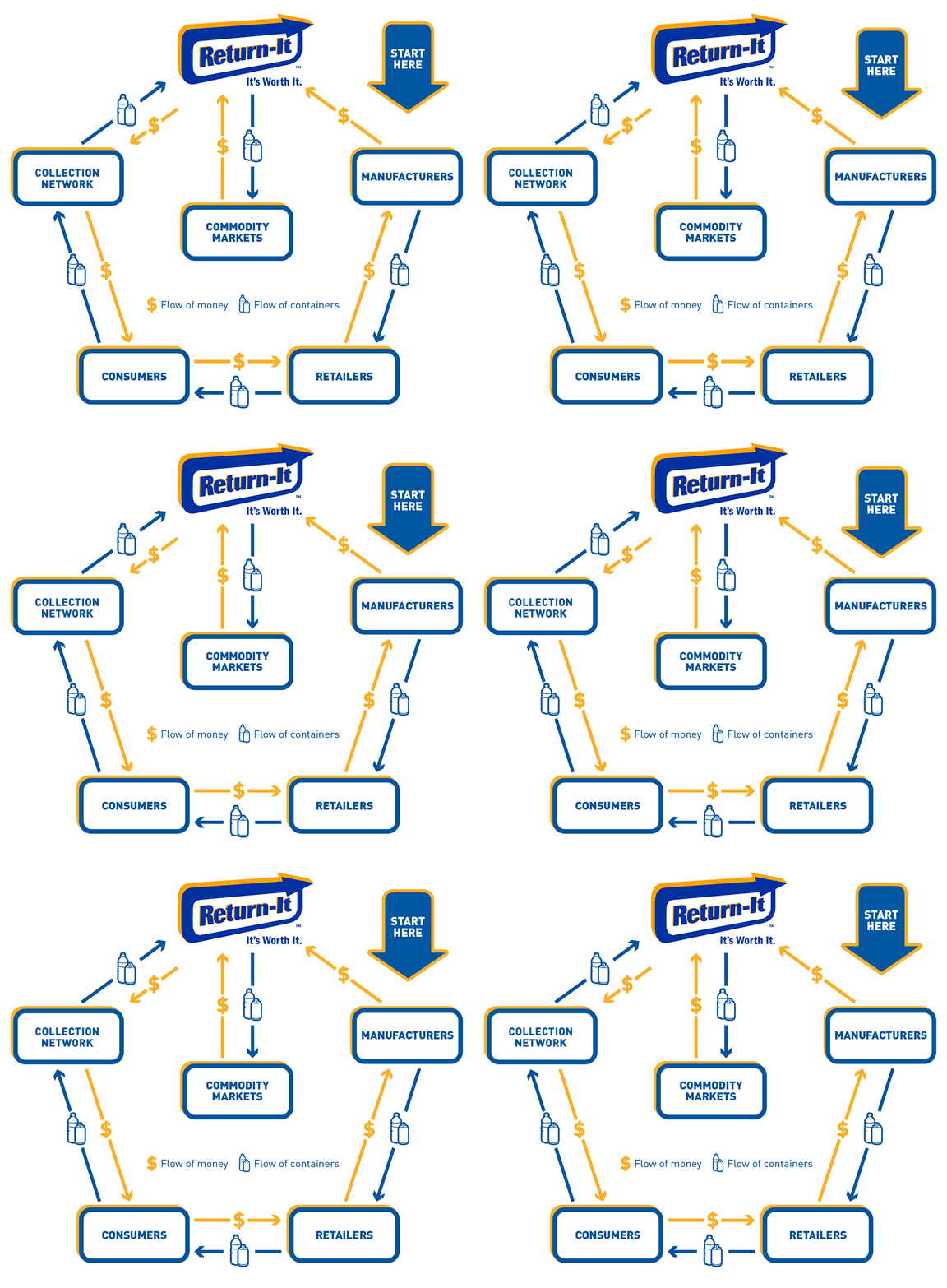
The arrows show the direction of payments for deposits and container recycling fees (CRFs) and the movement of beverage containers.
7.2 Follow the Money
Consolidated Revenues
Commodity Value from Collected Containers
Containers collected through the Return-It program are recycled into reusable raw materials. Each container type yields materials with its own commodity value, which is influenced by market conditions. These values fluctuate based on factors such as supply and demand, alternative container materials and tariffs.
Unredeemed Deposits
Encorp collects a deposit for every registered container sold in British Columbia. Unredeemed deposits for containers not returned by consumers are used to fund the system.
Container Recycling Fees (CRF)
When the revenue from the commodity value of collected containers and unredeemed deposits is insufficient to cover the net cost of recovering and recycling a specific container type, a container recycling fee (CRF) is charged on the specific container to make up the shortfall. The CRF is remitted to Encorp upon the distribution and sale of registered containers in BC. The CRF is not a tax or refundable deposit and is calculated annually to ensure the fee accurately reflects the costs required to deliver the program by Encorp, the not-for-profit organization designated as the Producer Responsibility Organization (PRO).
Other Fees and Income*
Revenues and income from service provider contracts.
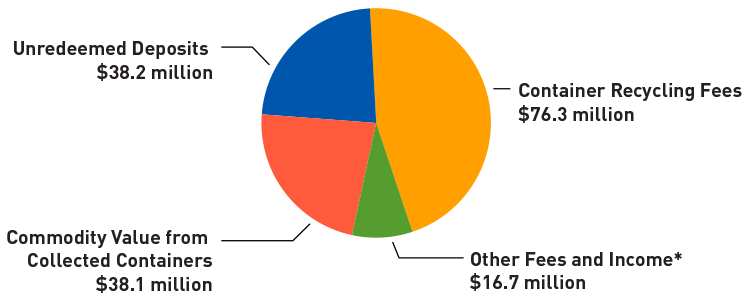
| Container Recycling Fees | $76.3 million | 45.1% |
| Unredeemed Deposits | $38.2 million | 22.5% |
| Commodity Value from Collected Containers | $38.1 million | 22.5% |
| Other Fees and Income* | $16.7 million | 9.9% |
| Total Revenues | $169.3 million | 100% |
*Other Fees includes professional services for Electronic Products Recycling Association (EPRA) and Major Appliance Recycling Roundtable (MARR), interest income and foreign exchange gain/loss.
Consolidated Expenditures
Deposit Refunds
Paid to depots and retailers to reimburse them for the deposits they have refunded to consumers.
Collection
Encorp largely delivers the Return-It program through a network of depots licensed to collect refundable beverage containers registered in the program. Contracted depots receive handling fees for collecting, sorting and preparing containers for transportation.
Transportation and Consolidation
Encorp contracts with various transportation companies to collect containers from depots and grocery retailers and deliver them to contracted consolidation partners, where they are sorted, compacted and prepared for shipment to end markets. For these services, Encorp pays transportation fees, fuel and processing fees to consolidators.
Administration
Administration and management of the recycling program for used beverage containers.
Consumer Awareness and Education
Cost associated with informing consumers about the Return-It beverage container return program, increasing awareness of return locations, and providing educational materials that encourage proper participation and higher return rates.
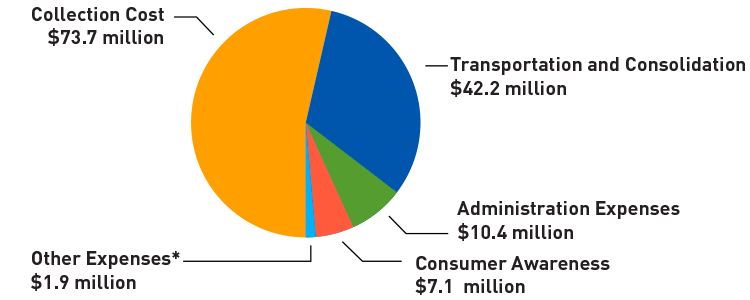
| Collection Cost | $73.7 million | 54.5% |
| Transportation and Consolidation |
$42.2 million | 31.2% |
| Administration Expenses | $10.4 million | 7.7% |
| Consumer Awareness | $7.1 million | 5.2% |
| Other Expenses* | $1.9 million | 1.4% |
| Total Expenditures | $135.3 million | 100% |
Note: Calculations may show slight variances due to rounding.
7.3 Container Recycling Fees (CRFs)
Container recycling fees (CRFs) are the fees Encorp charges its registered brand producers to cover the net cost of recycling a specific beverage container type after revenues from the commodity value of collected containers and unredeemed deposits have been used.
Encorp has developed a cost-effective system to recover and recycle all beverage containers registered with the Return-It program while ensuring producers pay the costs of collecting and managing products to end of life. As a not-for-profit stewardship organization designated as the Producer Responsibility Organization (PRO), Encorp relies on three sources of revenue to fund the Return-It program: the commodity value of collected containers, unredeemed deposits and container recycling fees (CRFs).
A CRF is required only when revenue from commodity sales and unredeemed deposits is insufficient to cover the net cost of recovering and recycling a specific beverage container type. Because commodity values and unredeemed deposits vary by container type, CRFs are calculated separately, with no cross-subsidization of cost between container types.
The CRF is not a tax or refundable deposit. It is calculated annually to reflect the actual costs required to deliver the program without generating unnecessary surplus. Brand producers remit CRFs to Encorp upon the sale and distribution of registered containers in BC. The fee is then passed through the supply chain and ultimately paid by consumers at the point of purchase.